
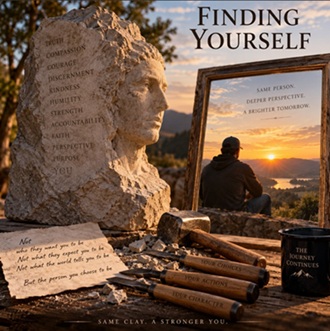
FINDING YOURSELF
I cannot help but wonder sometimes what goes through another person’s mind—or what, if anything, they are feeling in their heart.
So many things that were once unheard of, or at least kept out of sight, have become commonplace. Cruelty is dismissed as humor. Hatred is excused when it is directed toward the “right” person. Compassion has become conditional. Too often, we decide whether something is right or wrong only after we know who did it, or who it happened to.
Some religious leaders seem more invested in politics than in the Word of God. Things once considered shameful are sometimes celebrated. And increasingly, people seem willing to allow someone else to tell them not only what to believe, but whom to love, whom to hate, whom to trust, and whom to condemn.
Very few of us want to admit how easily we can be influenced.
We are like clay in the hands of sculptors. Politicians, preachers, commentators, celebrities, social media, friends, family, and algorithms all compete for the opportunity to shape us. If we aren’t careful, we can become someone else’s creation while remaining completely convinced that we are thinking for ourselves.
I have a philosophy of my own.
I choose to seek the truth. I try to step over the petty and insignificant and focus on the things that actually matter. I will listen to others, but I will decide what I believe. Most importantly, nothing another person says or does gets to determine the kind of person I become in response.
I am the sculptor of this block of clay.
That doesn’t mean I am always right. It doesn’t mean I cannot learn, change my mind, or discover that something I once believed was wrong. Quite the opposite. If I am truly responsible for shaping myself, then I have an obligation to keep examining the work.
Every day I see hatred and division. I see people working tirelessly to turn molehills into mountains, not because doing so will make anyone’s life better, but because winning the argument has somehow become more important than understanding one another.
And I find myself wanting to ask:
When did you lose your heart?
When did you lose your sympathy and compassion?
When did disagreement become hatred?
When did another person’s suffering become entertaining because you didn’t like that person?
When did you lose yourself?
How can any of us believe we are qualified to teach others about our ideals, thoughts, and dreams if we completely close our eyes, ears, minds, and hearts to the ideals, thoughts, and dreams of everyone else?
Listening does not require agreement.
Understanding does not require surrender.
Compassion does not require approval.
Those distinctions matter.
Social media can be enormously beneficial. It can also be devastating. In some ways, it has become the nuclear version of the old saying that the pen is mightier than the sword. A few words, a short video, or a carefully selected image can reach millions of people before anyone stops to ask whether what they’re seeing is true.
We should remember that much of what competes for our attention is also competing for money, ratings, clicks, influence, or popularity. Outrage attracts attention. Fear attracts attention. Anger attracts attention.
And today we have another complication: artificial intelligence can create convincing words, photographs, voices, and video. The technology itself is neither our conscience nor our enemy. The responsibility still belongs to us to question what we see and determine what deserves our belief.
Give 500 people the same book and ask each of them what it means, and you may receive 500 different answers. Many will be similar. Some will sound as though the readers were handed entirely different books. A few will dissect passages, remove context, reinterpret words, and then pinky swear they have quoted the thing word for word.
Human beings have always done this.
Technology has simply given us faster ways to do it.
So what is the answer?
That depends on you.
Are you satisfied because your cousin’s girlfriend said her best friend’s daddy’s coworker saw something on TikTok?
Or are you willing to put in the work required to discover the truth for yourself?
Seeking truth isn’t always comfortable. Sometimes the evidence confirms what we already believe. Sometimes it doesn’t. Sometimes the person we dislike is right. Sometimes the person we admire is wrong.
And sometimes the hardest words we will ever say are:
“I was wrong.”
That isn’t weakness.
It means you are still the one holding the sculptor’s tools.
I am a Christian. My faith influences the way I understand right and wrong, and I make no apology for that. But you do not have to share my faith to understand the basic principle I’m talking about.
Do not murder. Do not steal. Do not lie. Do not betray. Do not covet what belongs to another.
You can debate their religious origin, but it is difficult to imagine a society made worse by people striving to live by principles like those.
And that brings me to what caused me to write this in the first place.
I have watched people celebrate the death of another human being because they despised that person’s beliefs, politics, words, or actions.
That disturbed me deeply.
Not because I believe every person who dies was good.
Not because I think death erases someone’s mistakes.
And certainly not because I believe we should pretend that harmful actions never happened.
It disturbed me because I don’t want hatred to have that much control over who we become.
I have had people hurt me badly in my own life. There are people I could have every reason to resent. But I cannot imagine hearing that something horrible happened to one of them and celebrating it.
Not for their sake.
For mine.
Because the moment I allow another person’s cruelty to determine whether I possess compassion, I have handed that person the sculptor’s tools.
If I condemn cruelty when it happens to someone I love but celebrate it when it happens to someone I despise, then cruelty was never really the thing I opposed.
I merely opposed who received it.
A human life cannot acquire or lose all value according to which political box someone checks, what religion they practice, what color their skin is, whether they are rich or poor, male or female, educated or uneducated, straight or gay, powerful or powerless.
And compassion is tested most honestly when it is extended toward someone for whom compassion is difficult.
That doesn’t mean abandoning justice.
Compassion and accountability can exist together. We can condemn someone’s actions. We can demand consequences for crimes. We can protect innocent people. We can argue passionately about laws, government, morality, religion, and what kind of society we want to leave our children.
But somewhere along the way, we have to remember that the person standing across from us is still a human being.
That includes the person whose politics make your blood boil.
It includes the person whose religion you don’t understand.
It includes the person who has made terrible choices.
It even includes the person who has hurt you.
You don’t have to excuse them.
You don’t have to trust them.
You don’t have to invite them into your life.
You don’t even have to forgive them before you’re ready.
But you still get to decide what their actions will turn you into.
That’s the part I think we’ve forgotten.
We spend enormous amounts of time examining everyone else. Their politics. Their hypocrisy. Their failures. Their sins. Their stupidity. Their posts. Their past.
Maybe we need to spend a little more time examining the person in the mirror.
Ask that person some uncomfortable questions.
Who am I becoming?
Do I still have compassion for people who disagree with me?
Can I listen without immediately preparing my response?
Can I discover that I was wrong without feeling humiliated?
Can I condemn an action when my own side commits it just as quickly as I condemn it when the other side does?
Can I disagree with another human being without needing to hate them?
And when something terrible happens to someone I despise, what does my reaction say about me?
Those questions aren’t Republican or Democrat.
They aren’t conservative or liberal.
They aren’t Christian or atheist.
They’re human.
There will always be people who want to influence what you think. There will always be people who profit from your fear, anger, loyalty, or hatred. There will always be someone eager to put their hands on the clay.
But ultimately, you decide who gets the tools.
Other people may hurt you.
They may leave marks.
Life itself will certainly leave a few.
But those marks do not have to become your identity.
Take the tools back.
Think.
Question.
Listen.
Learn.
Have the courage to change your mind when truth demands it, and the courage to stand your ground when conscience demands that instead.
Choose compassion even when hatred would be easier.
Choose humanity even when your crowd gives you permission not to.
And above all, never allow another person’s hatred to decide how much love remains inside of you.
Because someday, after all the arguments are over, after the politicians, headlines, and social-media outrage have moved on to something else, there will still be one person you cannot escape.
The person looking back at you from the mirror.
Make sure you recognize them.
And if you don’t…
perhaps it’s time to find yourself.
Simply My Thoughts
Dean Butler
